
About Your Health
Healthcare now runs through homes, workplaces, communities, devices and apps. Intelligence shifts from the hospital core to patients, AI systems and specialist networks. What's the impact on brands?
TL;DR
Care is no longer somewhere you go. It is a mesh running through homes, workplaces, devices, and communities. The hospital is becoming one node in a distributed system, with intelligence shifting outward to patients, AI layers, and specialist networks simultaneously.
The most significant AI in healthcare right now is invisible. Ambient listening tools and documentation copilots sitting inside clinical workflows are reclaiming clinician time at scale, and the brands winning this narrative are framing AI as quiet relief rather than replacement.
Data governance is becoming a care feature, not a compliance footnote. As continuous data flows out of wearables, at-home diagnostics, and telehealth platforms, patient-controlled data architecture is emerging as a core part of the value proposition rather than a back-end consideration.
This week, I’m sharing some thought leadership work I did with a client. As some of you may remember, I built a trends graph for the Waldo team over the summer and over the last couple of months I’ve been using it to generate various research reports - including the To Be In 2026 report and this super fun piece on socializing and ‘Going Out’ trends.
The Waldo graph and the other PSFK graphs I’m building for my new project Fodda are based on a system that monitors week signals daily and then conducts pattern recongition across the data set once a month. I love how this tech allows multi-language, multi-region work - and I believe this global data delivery helps the graph users develop richer insights.
This week, I want to share the research the system helped me generate around health. We look at the healthcare continuum and how and where brands can play along it.
Health In Motion
Care used to be somewhere you went. A clinic, a waiting room, a ward with fluorescent strip lighting and daytime TV. Today it is turning into a mesh that runs through homes, workplaces, communities, devices and apps. Intelligence is shifting outward as well, from the hospital core to patients, AI systems and specialist networks.
In this newsletter we pull that shift into five big themes that show where health is actually happening in 2026, and where brands, agencies and platforms can credibly play along the new continuum.
1. Care Moves Home And Into Everyday Life
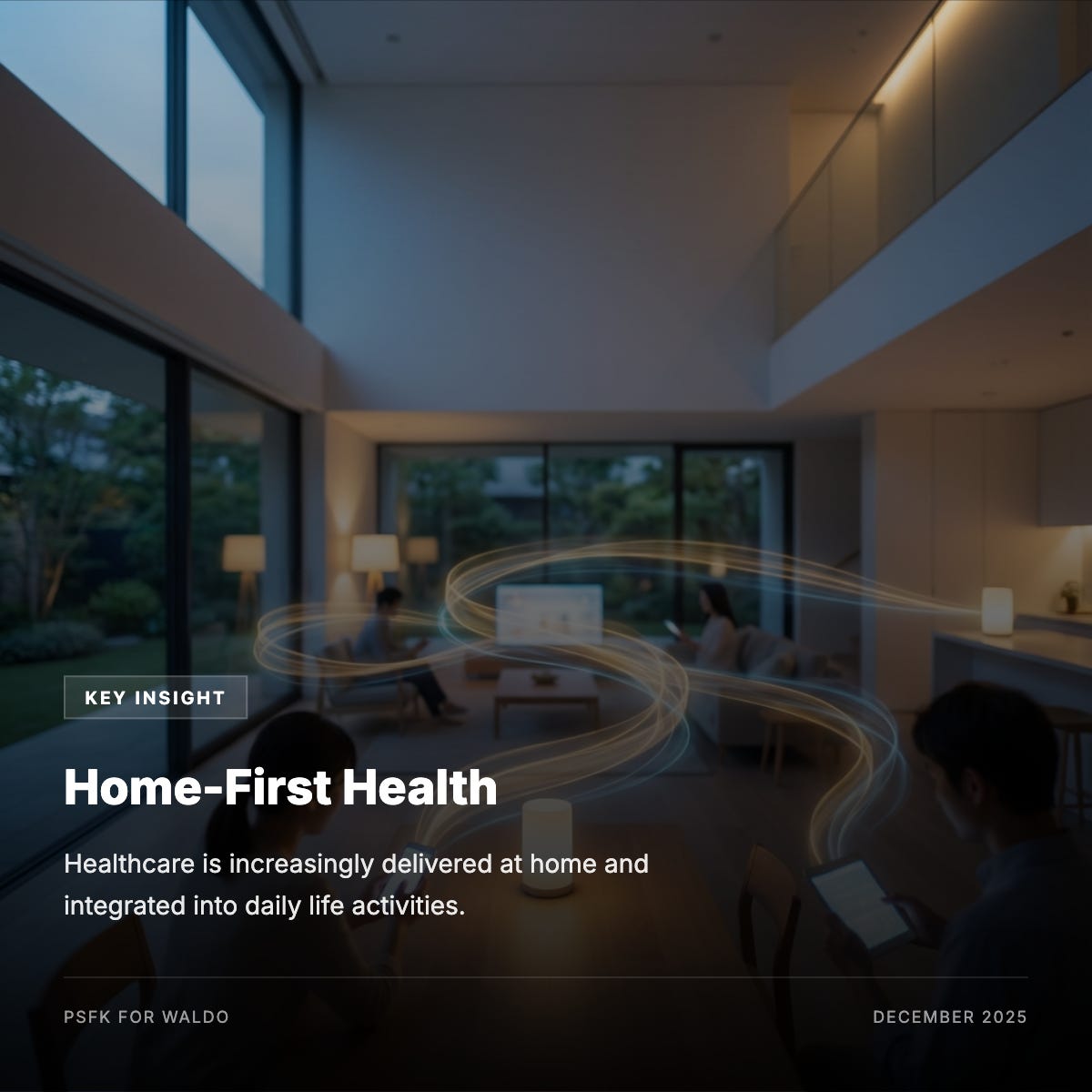
Across categories, care is leaking out of hospitals and clinics and into kitchens, bedrooms, driveways and neighborhood hubs. Hospital at home models let patients receive acute level care without ever stepping into a ward, combining in person visits, telehealth and remote monitoring.
You can see this in systems building full scale hospital at home programs and home hospital services, as well as new mobile acute care teams that turn bloodwork and diagnostics into a five minute errand rather than a half day trip. At the same time, consumer health is filling in with at home testing, smart rings and ear worn sensors that run vitals in the background.
What this means for brands
Map the home first journey around your product or service, from first symptom to kit on the counter to follow up and ongoing monitoring.
Prototype services that wrap around diagnostics, such as coaching, reminders and community clinic partnerships.
Treat community clinics, mobile units and neighborhood hubs as design partners, not just media channels.
2. Women’s Health Becomes An Orchestrated System
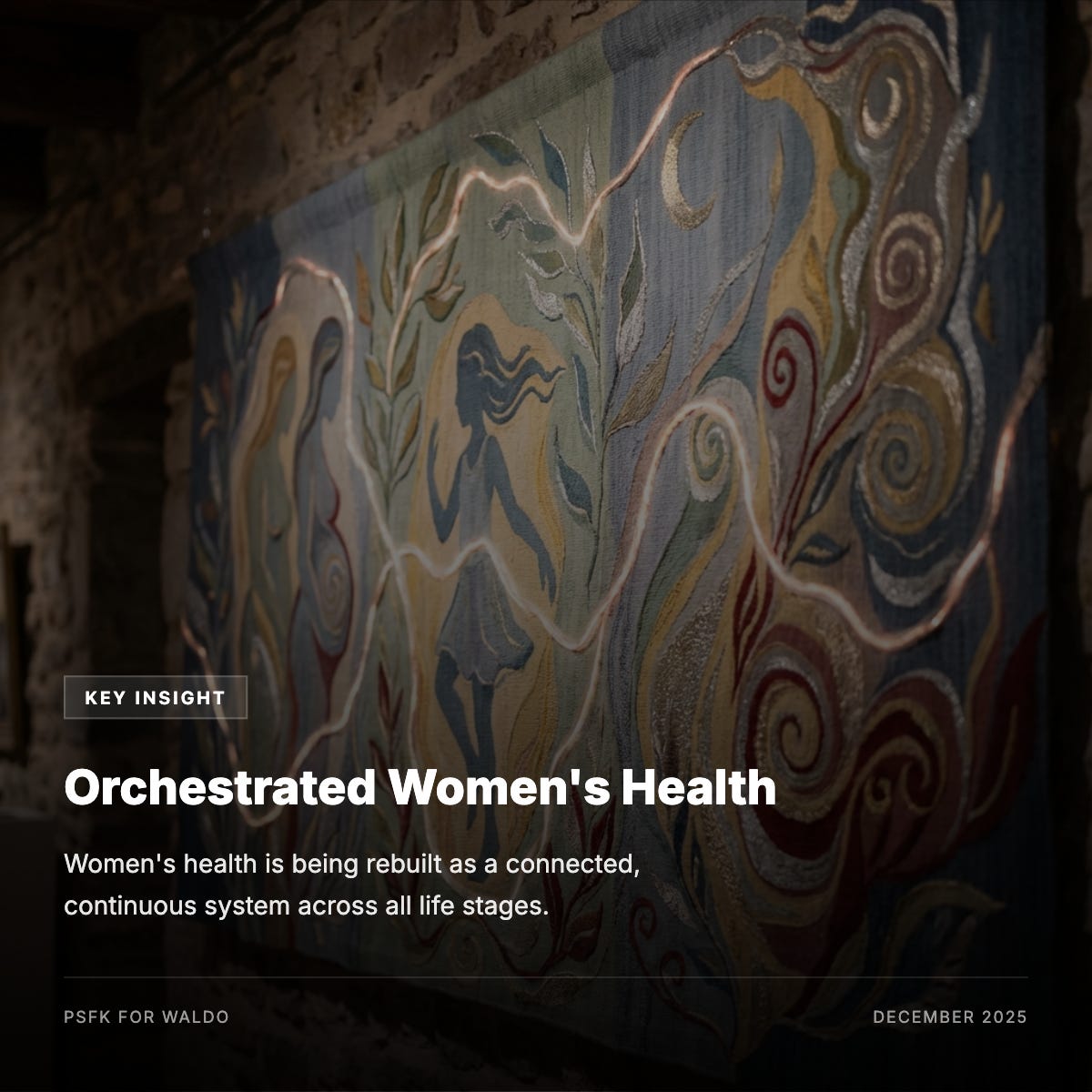
Women’s health has long been fragmented across specialties and life stages. Now it is being rebuilt as a connected system that runs from first period to post menopause. Virtual platforms like Maven Clinic position themselves as comprehensive women’s and family health across every life stage, while hybrid providers like Tia bundle primary care, gynecology, mental health and acupuncture under one roof.
On the ground, health systems are opening integrated centers like Mount Sinai’s Carolyn Rowan Center for Women’s Health and Wellness and Columbia’s Integrated Women’s Health Program which unite menopause, cardiology, mental health and more around one coordinated experience.
What this means for brands
Pitch life stage platforms instead of single indication campaigns, with continuity across fertility, pregnancy, menopause and beyond.
Design glue content that connects OB GYN, primary care, cardiology and mental health around shared risk stories and referral paths.
Build employer and payer facing narratives that tie better women’s journeys to measurable business outcomes.
3. AI Becomes The Invisible Operating System Of Care
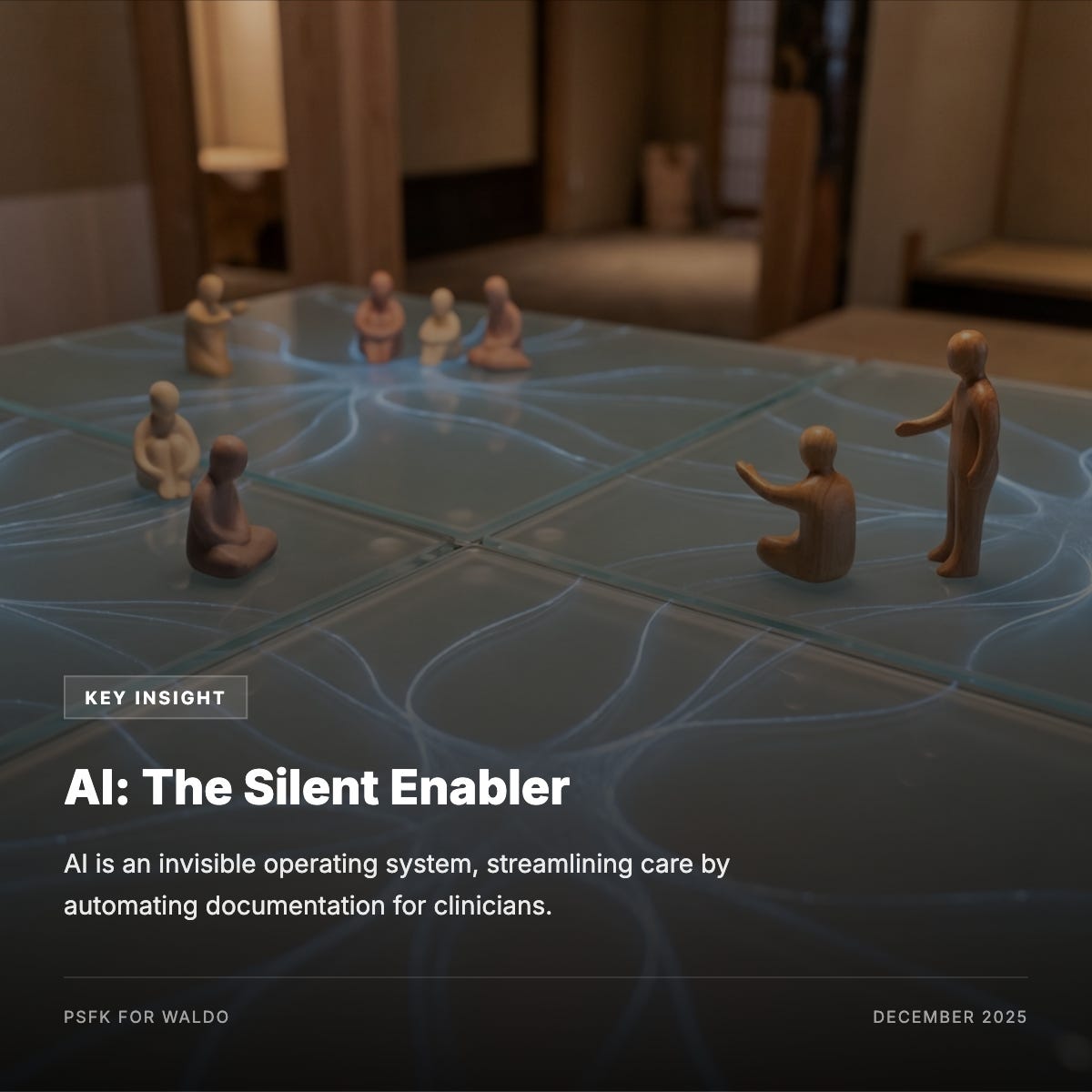
The most interesting AI in health right now is not a chat bot on a website. It sits in the plumbing. Health systems are rolling out ambient listening tools and documentation copilots that sit in the exam room, listen to the visit and write the note so clinicians can look at patients instead of screens.
Vendors like Abridge are being deployed across large systems including Johns Hopkins, Kaiser and Mayo to automate clinical documentation. Cleveland Clinic is using ambient listening software to reduce typing time for more than 4,000 physicians, while Microsoft’s Dragon Copilot pushes the same idea directly inside the EHR. Other tools like DAX Copilot and Tampa General’s AI powered ambient documentation target nursing workflows, where documentation burden is just as heavy.
What this means for brands
Narrate AI as quiet relief rather than replacement, and tie stories directly to reclaimed clinician time and reduced burnout.
Build simple internal guardrails for what counts as a credible AI claim so marketing does not outrun evidence.
Surface operational wins inside clinical storytelling, for example more bedside time or faster discharge, not only model accuracy.
4. Mental Health Everywhere, Not Just In The Clinic
Mental health has escaped the therapist’s office and single app icon. It shows up in workplaces, education, disease programs and always on peer networks. National platforms like the 988 Suicide & Crisis Lifeline and Crisis Text Line provide 24/7 access to human counselors through calls, text and chat, while agencies like SAMHSA push behavioral health into community programs and public campaigns.
These networks are being complemented by identity specific and situation specific support, from LGBTQ+ youth services to back to school mental health kits promoted through Crisis Text Line’s education resources. At the same time, AI is being woven into triage and routing, although recent investigations show many tools still struggle with something as basic as surfacing the right hotline number for someone in crisis. That gap is pushing regulators and advocates to demand more location aware, culturally competent support.
What this means for brands
Treat mental health as a default layer in health and life stage programs, not a side campaign.
Partner with established crisis and peer networks instead of building yet another standalone app.
For employer and payer facing work, package mental health screening, manager training and navigation alongside disease education.
5. Patient Controlled Data And Trust As Infrastructure
As continuous data flows out of wearables, at home diagnostics, telehealth and AI systems, the key question is who controls it. A new wave of platforms is trying to put patients, and sometimes their families, in charge. Apps like Vaultt position themselves as secure health information organizers that people own and control. Others, such as HealthVault / Cloud for Care and Patient Data Vault, build patient owned records and trial matching layers on top of structured data vaults.
The common thread is an architecture where individuals can see, manage and selectively share their records instead of leaving everything inside opaque hospital or tech platforms. These systems are emerging alongside new regulations and professional debates about how to use generative AI safely on health data, and how to keep sensitive information encrypted at rest and in motion.
What this means for brands
Make the data offer explicit in every digital concept. Spell out what people get back, how long information is kept and how consent can be revoked.
Turn privacy into part of the value proposition, with clear language about encryption, storage and sharing.
Design consent flows that are easy to revisit, not one time checkbox moments.
Final Takeaways
Across all five shifts, health is turning into an everywhere, all the time layer that surrounds people as they move through daily life. Homes, workplaces, communities and devices are becoming extensions of the health system. AI runs in the background as an invisible colleague. Women’s health and mental health are being rebuilt as longitudinal programs. Data governance is becoming part of the care experience itself.
For brands and agencies, the opportunity is not to bolt health themed campaigns onto old models. It is to work out where you can credibly plug into this new continuum, whether that means designing home first service journeys, orchestrating life stage ecosystems, building narratives that make background AI feel trustworthy, or treating privacy and control as core product features.
FAQ
What is driving the shift from clinic-based care to distributed, home-first health models? A combination of remote monitoring technology, telehealth infrastructure, and at-home diagnostic tools has made it commercially and clinically viable to deliver acute-level care outside hospital walls. The result is a health continuum that runs through kitchens, bedrooms, and neighborhood hubs rather than concentrating in centralized facilities.
How are brands expected to show up differently along the new healthcare continuum? The opportunity is not to add health-themed campaigns onto existing models but to identify credible points of entry into the new system: designing home-first service journeys, orchestrating life-stage ecosystems, or building narratives that make background AI feel trustworthy. Single-indication campaigns are giving way to longitudinal platform thinking.
Why is women’s health emerging as a distinct strategic priority for brands and platforms? Women’s health has historically been fragmented across specialties and life stages with little connective tissue between them. Platforms like Maven Clinic and hybrid providers like Tia are rebuilding it as a coordinated system spanning fertility, pregnancy, menopause, and mental health, creating new brand opportunities around continuity rather than condition-specific moments.
What does patient-controlled data architecture mean for brands building digital health products? As wearables, diagnostics, and AI systems generate continuous personal health data, consumers and regulators are demanding clarity on who owns it. Brands that make the data offer explicit, with clear language around encryption, consent, and revocation, are turning privacy into a competitive differentiator rather than treating it as a legal requirement.
Turn Your AI into a Health & Wellness Trends Expert with Fodda
The five shifts covered here are live signals inside the PSFK trend graph on Fodda, where curated expert sources track how care is being redesigned across homes, devices, workplaces, and communities. Give your AI the intelligence layer it needs to identify where your brand can credibly plug into the new health continuum.
Care is everywhere now. Your AI should be too.