
The Color Of The Food Experience Today - and More Design Flavors
A look at the design styles and elements used to shape our real-world social experiences.
Design is outranking the dish. Across hundreds of new bar and restaurant openings studied for the 200 Ideas report, ambience and interior design are functioning as the primary reason to visit, with color, materiality, and spatial mood doing the brand work that food and drink alone no longer can.
The dominant palette of the modern food experience runs green to red to brown with beige and gray at the edges. No purple. The color story of social dining in 2025 is warm, earthy, and grounded rather than bold or digital.
Technology has reached a deliberate plateau. Even the most forward-looking new hospitality spaces are hiding their tech rather than featuring it, signaling a collective agreement between operators and diners that the social dining environment should feel human-first and screen-free.
My latest report, '200 Ideas in Cafes, Bars, and Restaurants,' identifies 20 design trends shaping the hospitality and food service landscape. After studying hundreds of new restaurant and bar openings since June 1, 2024, this rather-hefty, 470-page report captures the themes that I saw running through the interior designs of incredible social spaces around the globe.

What Did I Learn?
Quite a lot about color use in these spaces. While the handy chart below presents the design themes defined from my research, it also indicates the dominant colors being employed in the cafes, bars and restaurants that fit within each theme. These are the colors of modern food experience today…. Notice the green to red to brown and a little beige to gray. No purple, sadly.

Design matters… maybe more than the food: while I was running pattern recognition across the images of hundreds of examples (that I had literally printed out and covered the floor of my dining room with) I read a fascinating piece by NY Times writer Priya Krishna about how some restaurants are valuing ambience over taste that backed up this macro theme I had been percolating.

The technology was hidden. Even in the most futuristic-looking eateries like Novu Waffle in Riyadh, Saudi Arabia, the tech wasn’t obvious. There were no big screens or ordering devices. It kinda feels that restaurants and their diners have agreed to camp at a technology plateau for now. Let’s hope it’s one where QR codes are only used for payment and never for menus. (« that did not appear in my research, just in my head.)
My report oversimplifies the interior design of modern restaurants and bars. What I noticed is how social spaces were employing 2 or maybe 3 different styles in one location. Sometimes a side room looked very different (in an exciting way), often the rooms in the basement embraced a darker, moodier, nocturnal approach.
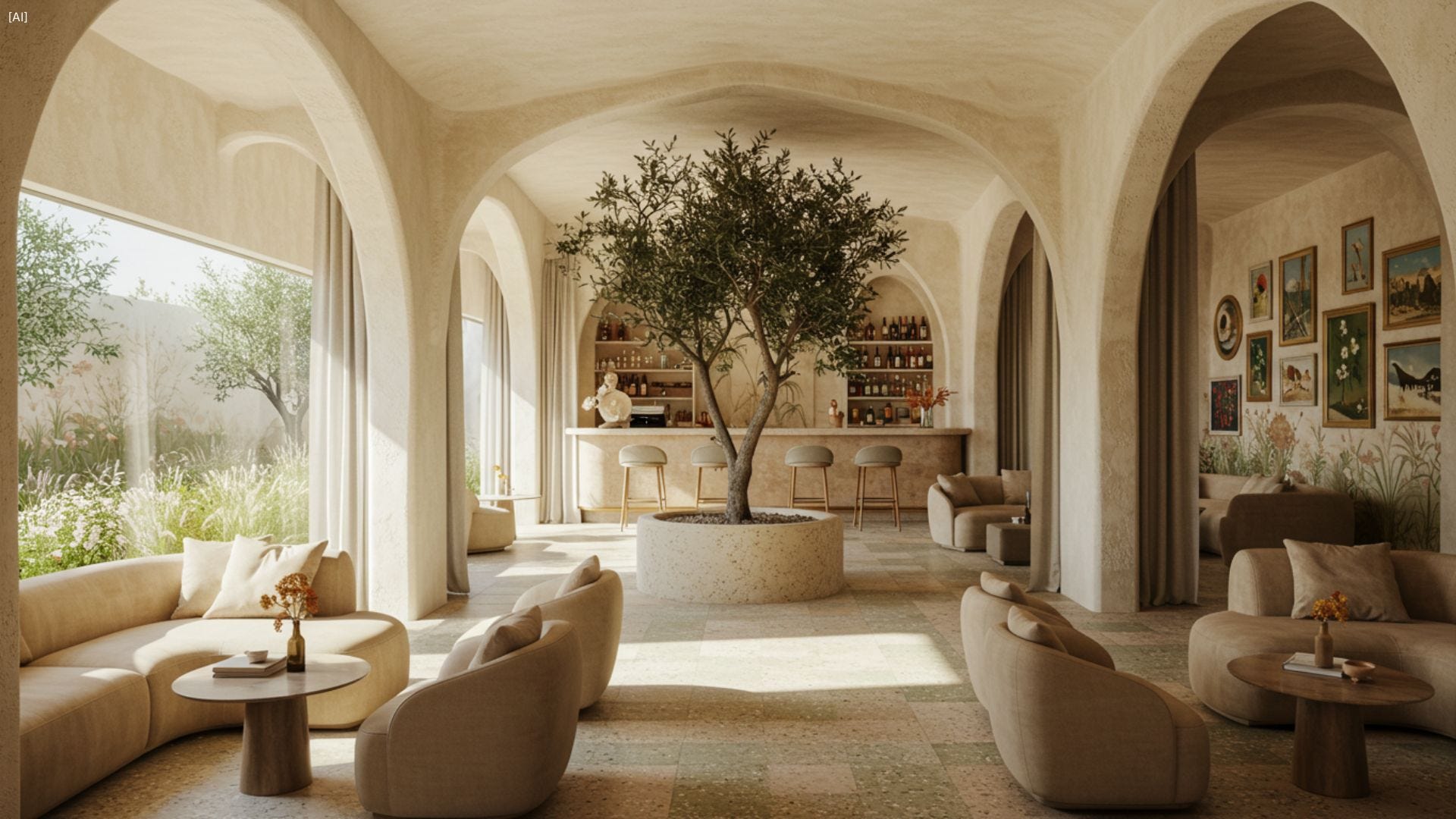
A number of design elements kept cropping up: record collections, galleries of photos and art, privacy curtains, the nature mural and, of course, the olive tree. As I tried to created an image that referenced many of the design themes for the cover of the report, I also tried to reference some of these elements into the image too:
10 More Video Mood Boards
Last week, I presented mood boards for themes like Microgrid Modern, Vermilion Drama and Framing Nature. Here are more clips that I developed (along with soundtracks(!!)) to bring 10 new themes to life.
New Tuscan: Mediterranean-inspired interiors emphasizing earthy color palettes and terracotta textures for warm, tranquil atmospheres.
Continental Neutrality: Understated luxury and European-inspired interiors characterized by muted palettes and refined elegance.
Framed Rigor: Structured geometric interior designs creating visually engaging and sophisticated hospitality environments.
Eclectic Palette: Bold, Mediterranean-inspired interiors featuring vibrant colors, artistic accents, and dynamic visual combinations.
Orbital: Futuristic hospitality design concepts with seamless forms, minimalist precision, and subtle integration of advanced technology.
Urban Jungle Retreat: Lush greenery and organic textures transform interiors into relaxing, nature-infused sanctuaries within urban settings.
Open Assembly: Adaptable, open-plan spaces designed for flexible social interactions, mixing functional modularity with contemporary aesthetics.
Crimson Cocoon: Warm, enveloping interiors featuring soft, rounded forms and rich, deep-red hues to create intimate, cocoon-like spaces.
Gilded Times: Opulent, historically inspired interiors blending gold accents, luxurious textures, and refined craftsmanship for timeless sophistication.
Quiet Craft: Serene, minimal spaces emphasizing artisan details, subtle textures, and natural materials to foster calmness and authenticity.
FAQ
Why is interior design becoming a more important driver of restaurant success than food quality? As dining out shifts from a purely culinary decision to a social and cultural one, the environment signals belonging, taste, and identity before a single dish arrives. Research and editorial coverage from outlets like the New York Times are now tracking how operators are explicitly prioritizing ambience investment over menu development as the primary tool for driving visits and repeat behavior.
What are the dominant design languages shaping hospitality interiors right now? The PSFK research across 20 identified themes points to a broad move toward warmth, materiality, and craft: New Tuscan earthiness, Continental Neutrality’s muted refinement, Quiet Craft’s artisan minimalism, and Crimson Cocoon’s intimate enclosure all reflect a hospitality market gravitating toward analog comfort over futuristic spectacle.
Why are restaurants deliberately hiding technology rather than showcasing it? The social dining environment has become one of the few contexts where consumers actively want relief from screens and interfaces. Operators appear to have recognized that visible technology disrupts the atmosphere premium they are selling, making concealment a design strategy rather than a constraint.
What does the recurring presence of design elements like record collections, nature murals, and olive trees signal about hospitality branding? These recurring motifs point to a shared visual grammar emerging across global hospitality that communicates authenticity, locality, and cultural curiosity without requiring explicit brand messaging. They function as shorthand for a certain kind of operator sensibility that socially attuned diners recognize and self-select toward.
Turn Your AI into a Retail & Hospitality Trends Expert with Fodda
The design themes, color palettes, and spatial strategies shaping the modern food experience are part of a broader set of signals tracked inside the PSFK Retail Intelligence graph on Fodda. Whether you work in hospitality, brand strategy, or commercial interior design, giving your AI access to curated trend intelligence means you stop reacting to what opened last month and start anticipating what opens next.
The room is the brand now. Make sure your AI knows what it looks like.
Explore the PSFK Retail Intelligence Hub on Fodda
